Showing posts with label Peter Davison. Show all posts

Saturday, January 8, 2011

66. The Game.


6 episodes. Approx. 118 minutes. Written by: Darin Henry. Directed by: Gary Russell. Produced by: Gary Russell, Jason Haigh-Ellery. 


THE PLOT

The planet Cray has been in the midst of a brutal civil war for generations - but it isn't recognized as a war. The violence is confined to a game known as "Naxy," in which teams representing the planet's factions battle to the death in an arena. Whichever team kills the most opposing players by the time the buzzer sounds, wins the match. Tens of thousands die each year, and the entire society is structured to make sure the game continues in perpetuity.

The Doctor has to come to Cray to witness the final peace negotiation of one of his heroes, the legendary diplomat Lord Darzil Carlisle (William Russell). But he quickly finds himself pulled into the world of Naxy, playing for the losing Lineen. Once he realizes the nature of the game, he tries to stop the bloodshed - but his efforts only end up making things worse, as his attempt to lead an escape transforms into a vicious massacre!

At least he can count on Lord Carlisle to stop the carnage. But Carlisle hides a secret of his own. He has never actually negotiated any of the peace treaties credited to him. He relied on help from a friend, a figure who created peace and then pushed the credit onto Carlisle: The Doctor! 


CHARACTERS

The Doctor:
 The early episodes allow Peter Davison to play something unusual for the Doctor: fannishness. His hero worship of Carlisle makes for some amusing moments, and Davison plays it to the hilt. His enthusiasm in the early episodes emphasizes how bitter his disappointment is when he sees Carlisle's ineffectual performance at the peace talks. "Never meet your heroes," he snaps disgustedly, still unaware that the secret to Carlisle's success is actually a future version of himself.

Nyssa: Bonds with Lord Carlisle, her lack of preconceptions about him allowing her to see him clearly. She recognizes that while he's in over his head, he is nevertheless a good man. This leads to her (short-lived) decision to stay with Carlisle as his aide. She justified her decision to the Doctor very simply: "He needs me more than you do." It's a rationale that suits Nyssa's character perfectly, and ties in well to her ultimate departure on television.

Lord Carlisle: William Russell, one of the original stars of Doctor Who, is marvellous as Carlisle. It's a very different role than Ian Chesterton - and though Russell's voice is instantly recognizable, he creates a very different performance. He projects an avuncular warmth, particularly in his scenes with Nyssa, but there's also a note of fear that creeps into his voice. He knows he isn't up to doing the job himself, and when he realizes that the Doctor on Cray is not the man he's come to know, he grows extremely nervous. The final scene between Davison and Russell is particularly strong, with both actors at the top of their respective games.


THOUGHTS

Darin Henry is an extremely successful television writer and producer, with credits on both American and British television: Seinfeld, Futurama, and The War at Home being just a small sampling of a very long list of titles. It's fair to say that his writing a Big Finish audio - and doing so at a time shortly before Doctor Who returned to television - was a bit of a coup for the small audio production company.

For his script, Henry has crafted a six-parter. Not in length, mind you: Thanks to some aggressive script editing by Gary Rusell (who saw the script's length and worried that it would end up at 3 - 4 hours), The Game ends up with the running time of the average Big Finish four-parter. This probably is actually a good thing. This is an action piece, and by making it as tight and fast as possible, the energy that is the story's strength is never allowed to lag. Scenes are mostly very short, plot developments come at a rapid pace, and what we're left with is akin to a high-speed rollercoaster. Not that I wouldn't be interested in knowing what was cut, but I suspect the cuts were for the best.

The six-part structure is the classic 4 + 2 construction advocated by Robert Holmes. The first four episodes focus on the brutal game of Naxy and the peace talks that hope to end it. The last two episodes shift gears and turn the story in a different direction. The shift is well done, taking place at a dramatic high point - a moment that would inevitably see the Naxy story resolved in any case, so we don't feel cheated out of the first story by moving to the second. Groundwork is laid in the early episodes, as the Doctor and Nyssa discover incongruities that create questions to be answered after the focus shift. And the change in direction does exactly what it's always been intended to do in six parters: Keep up the energy by giving the audience something new.

Big Finish's production standards are at their best. Episode Two is dominated by a large-scale action scene, the sort of thing audio often struggles with. Here, it works a treat. By staging the bloodshed in the context of a "sport," Henry's script is able to use sports announcer Garny Diblick (Jonathan Pearce) to describe what is occurring in the arena. Description is about what you would get from an actual sportscast - enough to complement the field action for viewers and to allow listeners to follow it, but not so much as to come across as forced. Everything is very tightly edited, and the sound effects, performances, and writing come together to create a breathless sequence.

The ending does feel a bit rushed, and obvious set-up for a recurring villain in the form of crime boss Morian (Christopher Ellison) ends up going nowhere, as Morian never recurs - something I'm quite fine with, since he's not the most interesting of villains anyway. The climax still works reasonably well, though, and the tag scene between the Doctor and Nyssa is highly effective. 

It may not be quite as good as Spare Parts or Creatures of Beauty, but then few stories are. The Game is breathlessly paced and does a fine job of making a very violent action story nevertheless fit perfectly within the Doctor Who framework. 


Overall Rating: 8/10.


Previous Story: Creatures of Beauty
Next Story: Circular Time - Spring (not yet reviewed)

Search Amazon.com for Doctor Who

5th Doctor Audio Review Index

5th Doctor Television Review Index

Doctor Who Monthly Adventures Review Index

To receive new review updates, follow me:

On BlueSky:

On Threads:

Saturday, January 1, 2011

44. Creatures of Beauty.


4 episodes. Approx. 109 minutes. Written by: Nicholas Briggs. Directed by: Nicholas Briggs. Produced by: Gary Russell, Jason Haigh-Ellery. 


THE PLOT

The planet Veln has been devastated by an accident that wasn't even their doing. The explosion of a Koteem ship, which was illegally transporting dyestrial waste across the Veln system, has left their world devastated.  The radiation has horribly disfigured the population, and the Veln race is now mere generations away from extinction.

When the TARDIS materializes on Veln for self-repairs, the Doctor and Nyssa find themselves thrust into the aftermath. Nyssa is picked up by security forces, who suspect her of being a Koteem infiltrator. Meanwhile, private security man Quain (Nigel Hastings) brings the Doctor to his employer, Lady Forleon (Jemma Churchill). Forleon has a plan to save at least some of the Veln people - but her methods have put her squarely in the sights of Veln Security Chief Gilbrook (Dvaid Daker), a brutal man who despises privileged "beauties" like Forleon and has dedicated his life to purging Koteem influences by the most violent means possible!


CHARACTERS

The Doctor:
 Spends this story in a particularly philosophical mood. The first episode opens with a scene in which he and Nyssa, while escaping from the security forces, talk about all they have experienced on this planet. The Doctor muses about how both groups - Gilbrook's security forces and Lady Forleon's underground group - have points of view that are entirely valid to them. Witnessing the mess that Veln has become, he determines to just get himself and Nyssa out in one piece, and otherwise not interfere. Peter Davison is on splendid form. The Doctor is largely powerless in this story, but he never acts it. He works out the basic purpose of Lady Forleon's surgical equipment at a glance, insists that he will rescue Nyssa alone if she and Quain won't help him, and faces down the Koteem with poise.

Nyssa: Refuses to be intimidated during her interrogation. When Brodlik (David Mallinson) repeats the official line that she was violent when arrested, Nyssa firmly points out that the only violence came from the arresting officers. Her defiance gradually catches Brodlik's attention, shaking his certainty of her being a Koteem. She's arrested in the first place because of her compassion - She isn't able to stand by and watch Veline (Emma Manton)'s distress without trying to help.

Gilbrook: There are several strong guest characters and performances in this story, but the strongest presence by far is Security Chief Gilbrook (David Daker). He's a monstrous figure, defined by his brutal resentment of the Koteem. But Daker is such a strong presence that he isn't merely monstrous. There's nothing sympathetic or likable about the man, who spits out "beauty" as an insult (every time he does, I can literally picture the saliva flying). Still, there's a purity to his rage which makes him impossible to dismiss. He also gets one of the story's most memorable reflective moments, remembering his great-grandfather witnessing the original disaster and calling it "beautiful" - bringing full circle a refrain of the word "beautiful" that has bridged many moments in the piece.


THOUGHTS

"Sometimes, if you stare at a painting for too long and get too close to it, all you can see are the brushstrokes. The harder you stare, the more formless and meaningless it seems to become." 

This quote of the Doctor's could apply as well to the storytelling structure of Creatures of Beauty as it does to the situation with the Veln and the Koteem within the story. Creatures of Beauty is told non-consecutively, starting around the middle of the story and moving both backward and forward from that point until we finally step back far enough to see the complete picture.

Each episode focuses on a certain piece of the overall situation, getting in close to focus on specific brushstrokes. At the same time, each episode shows a little more of the overall picture. Each part begins with events preceding anything from the previous episodes, and each part ends with events following everything from the previous episodes. In between, we move in close again to focus on another brushstroke.

Part One focuses on Gilbrook, Brodlick, and the security forces. This focus not only gives us the "official" view of the Veln reacting to damage done by the Koteem - It also doubles as a way to ease us into the narrative style. A prologue gives us bits and pieces from throughout the story, then we get one scene from after the Doctor and Nyssa escape, presenting the idea of viewpoints and tipping us off that we're not going to be seeing events unfold in consecutive order. The bulk of the episode, however, is framed by Brodlick's report to Gilbrook on his interactions with Nyssa. All the remaining events are put into context by the Brodlick/Gilbrook scenes, which build to a climax of their own by the episode's end.

Part Two focuses on the Doctor, viewing the activities of Lady Forleon and Quain from an outsider's perspective. The level of discontinuity is increased: We pick up with the Doctor's arrival at the Forleon estate, with Nyssa's arrest occurring off-camera; then we cut forward to events that take place after their escape. Part Three then shifts focus to the viewpoints of Lady Forleon and Quain, showing their actions in the context of people desperate to do something to save their people and culture. This time, we pick up just before the Doctor's arrival and end with the Doctor and Nyssa leaving the planet, commenting on how little they actually accomplished here.

Any listener could be forgiven for thinking the story was over at this point. But the final episode snaps everything into focus. We begin just before the accident that contaminated Veln, and we end after the Doctor and Nyssa have departed. We step back to take in the full painting, and all the brushstrokes we've been examining become parts of the larger work at this point. And we see that the Doctor and Nyssa are much more a part of this than they ever would have suspected.

This is a polarizing story. Most listeners fall into two camps, between those who find it excellent and those who find it dreadful. From writer/director Nicholas Briggs, whose scripts tend toward the traditional, this experimental piece is a huge departure.

As should be very apparent from this review, I fall into the "excellent" camp. Briggs has taken care with his non-consecutive structure, making sure that the work is easy to follow at all points. He's also penned some of the best dialogue in any of his scripts, from the Doctor's philosophical musings to Gilbrook's angry rants about how, to him, Lady Forleon and his people who flout the law are "ugly." 

It lacks the significance to the larger Who franchise that Spare Parts had. But in its way, it's every bit as good a story. It's the second 5th Doctor/Nyssa story in a row to earn full marks, and really shows what a strong period in Big Finish's history this was.


Overall Rating: 10/10.


Previous Story: Spare Parts
Next Story: The Game

Search Amazon.com for Doctor Who

5th Doctor Audio Review Index

5th Doctor Television Review Index

Doctor Who Monthly Adventures Review Index

To receive new review updates, follow me:

On BlueSky:

On Threads:

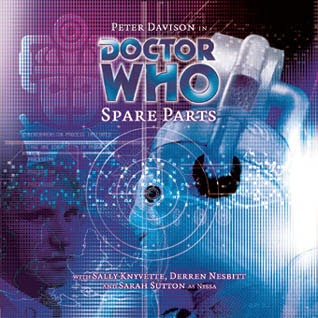
34. Spare Parts.


4 episodes. Approx. 120 minutes. Written by: Marc Platt. Directed by: Gary Russell. Produced by: Gary Russell, Jason Haigh-Ellery. 


THE PLOT

The TARDIS materializes on the planet Mondas - the homeworld of the Cybermen. Though the Cybermen have not yet replaced the human race, Mondasian humanity is in its dying days. The surface of the rogue planet has frozen over, driving the survivors underground. Only one human city still stands, its population afflicted with illness. Crews are selected from the sickest of the residents. They are processed, "augmented" with cybernetic technology in order to work on the otherwise uninhabitable surface, building a planetary propulsion system to return them to their home sun.

Once the Doctor realizes where they are, he insists that they cannot interfere and should leave immediately. But Nyssa has already befriended the Hartley family, recognizing them as good people undeserving of the fate that awaits them. She pushes the Doctor to at least intervene a little... and that little is enough to mark them as outsiders, with the Cyber-augmented "planning committee" ordering them arrested and brought in for interrogation!


CHARACTERS

The Doctor:
 Recognizes very quickly that this is Mondas before the Cybermen, something he tries to conceal from Nyssa. When she confronts him at the end of Part One, he insists that neither of them can change this world's fate. Even so, he can't stop himself from making multiple attempts to wake the people of Mondas up to what is happening around them. The future may be inevitable, but when the horror is right in front of his face, he will make an attempt to shift its course. Peter Davison has rarely been better, compassion, sarcasm, and an angry ferocity he was too often denied by his television scripts all perfectly balanced.

Nyssa: While the Doctor makes an inevitably doomed attempt to alter the future on a large scale, Nyssa helps on a smaller one: Helping to fix Mr. Hartley (Paul Copley)'s mechanical heart, for instance, or bringing food to the Hartley family to repay what she has eaten. She continues to feel pain at Adric's death, and seeing the birth of the Cybermen makes that all the stronger. When the Doctor urges that they should leave at the end of Part One, she wields Adric's fate like a weapon against his arguments. 

Cybermen: Several of this serial's Cybermen are first seen as human characters. One is plucky and likable, another officious and humorless, yet another rather shady and potentially dangerous. All are fully human creations, which makes it that much more effective to see them reduced to machines by the story's end. Nicholas Briggs voices most of the Cybermen, and offers a different sound for each stage. The recognizably human police are presented as semi-Cybermen, with a light electronic treatment given to a voice recognizably Briggs' own. The full Cybermen, little heard in the story's first half, have the full Tenth Planet voices. The lead Cyberman, Commander Zheng, also has that voice but with a deeper tone. This makes it easy for the listener to differentiate one "class" of Cyberman from another, aiding visualization while showing each successive generation moving further away from human and toward machine.


THOUGHTS

Spare Parts is Doctor Who's best Cyberman story. I make this statement without any equivocation. It is not merely the best Cyberman story on audio. It is the best Cyber-story across all media and all incarnations of the Doctor Who franchise.

I did enjoy the new series' Rise of the Cybermen, which recycled a handful of the ideas from this audio into an effective television action story. But this is a much more meaningful piece, with far greater emotional impact. Writer Marc Platt hasn't turned out an action story, though there's certainly action in it. As he explains in his author's notes, he rejected the idea of having a "Cyber-Davros" (something this story's television counterpart did indulge in), and instead crafted a human tragedy.

The most memorable scene comes in Episode Three. A power outage has interrupted a Cyber processing line, and one of the half-processed Cybermen has enough of its human memory to find its way home, to a reunion with its family. The reunion scene is genuinely devastating, one of the most vivid single moments in all of Doctor Who.

Russell Stone contributes another terrific score, starting with a jaunty patriotic tune accompanying a newsreel, then distorting that same tune into something discordant and mournful. The score gradually moves toward the mechanized as the Cybermen move from the periphery of the narrative to the center of it, until we get a full Cyber-score backing the action of the final episode. 

Guest performances are mostly excellent, in well-realized roles. Special mentions go to Sally Knyvette's Doctorman Allen, taking refuge in heavy drink and cynicism as she sees her good intentions transforming into something monstrous; Paul Copley's warm but defiant Mr. Hartley; Darren Nesbitt's grasping, deceitful Dodd; and of course, Nicholas Briggs' Cybermen. The only weak link in the cast is Jim Hartley as young Frank Hartley, who starts out sullen and resentful before emerging as an ally. Hartley's wooden line readings contrast sharply with the outstanding performances surrounding him. Fortunately, it's a decidedly supporting role and his relative weakness does little damage to the piece.

Released in 2002, Spare Parts remains not only a highlight of the Big Finish audio range but one of the entire Who franchise. It is fortunate that when the new series produced Rise of the Cybermen, the decision was made to set it in a parallel reality so as not to conflict with this story. If the two Cyber-origin stories had conflicted, I'm sure I'm not the only one who would have chosen this one over its television counterpart.


Overall Rating: 10/10.

Previous Story: Primeval
Next Story: Creatures of Beauty

Search Amazon.com for Doctor Who

5th Doctor Audio Review Index

5th Doctor Television Review Index

Doctor Who Monthly Adventures Review Index

To receive new review updates, follow me:

On BlueSky:

On Threads:

26. Primeval.


4 episodes. Approx. 108 minutes. Written by: Lance Parkin. Directed by: Gary Russell. Produced by: Gary Russell, Jason Haigh-Ellery.


THE PLOT

Nyssa is gravely ill, and the Doctor can find no cause for her sudden sickness. With all of Time and Space at his disposal, he has brought her to the one place where she can find healing: her home planet Traken, roughly 3,000 years before its destruction.

He has brought Nyssa to Shayla (Susan Penhaligon), the foremost healer in all of the planet's history. What he doesn't realize is that these are also Traken's primeval times, a time of superstition when the consuls all but worshipped the artificial sun known as "The Source," whose energy keeps out all evil influences. The ruling Consuls, Janneus (Rita Davies) and Hyrca (Mark Woolgar), see the Doctor as a pernicious influence and insist that he and Nyssa must leave immediately. When Shayla protests that this will mean Nyssa's death, the consuls declare this a small price to pay for the good of their ideal society.

An appalled Shayla gives the Doctor another lead to follow: Kwundaar (Stephen Greif), a malevolent being who leads an army that worships him as a god. Kwundaar's fleet constantly circles Traken, kept at bay by the power of The Source. He is tremendously powerful and tremendously dangerous - but he will be able to save Nyssa. There is a price, however, and if the Doctor pays it then it will mean the total destruction of Traken!


CHARACTERS

The Doctor: Rejects the Trakenites' black-and-white view of good and evil. "I've traveled quite widely, met the most terrible people with the most appalling beliefs. I consider them evil. But I'm sure if you were to ask them, they'd tell you that I'm the monster, not them. Evil is relative." He sees Kwunddar's followers as more misguided than anything. He respects Kwundaar's captain, Narthes (Billy Miller), for his desire to provide a better life for his children, and he clearly pities the devout young Lt. Anona (Romy Tennant), whose harsh life has made her entirely too receptive to Kwundaar's deadly philosophy. None of this stops him from wanting to defeat Kwundaar, but it makes his interactions with the "dark god's" followers much more interesting than might have been the case.

Nyssa: Even when deathly ill, she remains protective of the Doctor. She stands up for him to the Consuls, denouncing their superstitious fears and scornfully saying that they should be ashamed of themselves. She also shows resourcefulness when confronted by Anona near the end. Very Doctor-like, she manages to defeat Anona despite being unarmed and having no advantage other than her quick wits.

Kwundaar: Primeval has generally strong guest characters and performances, but Stephen Greif's Kwundaar is the clear standout. He's a villain, but he's not just a villain. As his backstory is revealed, we see that his hatred of the Traken people is far from unmotivated, and there's something almost tragic about his sad reflection that "Everyone betrays me." Like a lot of Big Finish alien villains, his voice has been electronically treated. Unlike many cases, the treatment works perfectly. It's light enough that Greif's own silky, seductive delivery comes through the effect. He shifts from soft to harsh and back again, and the effects don't get in the way. And as he speaks, we hear the howls of the Damned echoes within the treatment given his voice - shrieks of torment that, by the story's end, seem to reflect the pain not of Kwundaar's victims, but of Kwundaar himself. An excellent villain, well-performed and well-presented.


THOUGHTS

Primeval returns us to Traken, giving us a look at its distant past while centering the narrative on the Doctor and Nyssa. Lance Parkin's script cleverly links this young Traken to the world seen on television. In this way, it is able to act as both sequel and prequel to The Keeper of Traken, more fully developing the planet's history and society while showing the birth of the "Keeper" system.

That makes it interesting from a continuity perspective, but Primeval is much more than fan service. Parkin has written an intelligent script, one that examines questions of good and evil in a way that's less superficial than the average Doctor Who runaround. And it does so while still managing to a good, fast-paced yarn.

Faith is a major thematic centerpoint. Kwundaar's followers and the Traken consuls are paralleled at many points, both groups blind in their faith. Narthes describes his service to Kwundaar: "I worship him, follow his commandments. He grants me all I ask for, intervenes on my behalf. There's not many that can say that about their god." In return for Kwundaar's intervention, his followers in their blind faith perpetrate destruction on a massive scale.

But the faith of the Traken consuls is equally toxic, as they pronounce the perfection of their own society and elevate their artificial sun into a deity in deed, if not in word: "The Source guides us. The Source is perpetual, infallible. We bathe in its light, while the lesser races must skulk in the shadows... The whole universe envies us!" There are more similarities than differences between the two pronouncements, and we see the consuls willing to execute innocents and ignore the deaths of non-Trakenites as irrelevant all in the name of their self-pronounced "perfection."

Nyssa's faith in the Doctor is the contrast. She continually voices her faith in his goodness and is certain that he will save her, then that he will save Traken. But she is very willing to question him, and is quick to point out the way in which he falls straight into Kwundaar's trap. Her faith is genuine, but it isn't blind, and so comes across as far healthier than the single-minded worship of either Kwundaar's people or the Traken consuls.

Lest this come across as wordy and actionless, it should be said that the story involves a fleet of ships, with Nyssa and the Doctor under constant threat from either the Traken consuls, Kwundaar's followers, or both. By the end of Episode One, we've heard one supporting character's disintegration. By the end of Episode Two, there has been a desperate escape, one that we learn is actually part of a trap the Doctor is falling directly into. The final episode could accurately be described as an action piece. It's just it isn't dumb action, and when the characters talk, their words are well worth hearing as much for the pleasure of the dialogue as for advancement of the plot.

Fast-paced, deceptively thoughtful, and populated by interesting and well-performed guest characters, Primeval is one of the highlights of Big Finish's first three years. It's one that I regard as a personal favorite, and I have no hesitation in recommending it highly.


Overall Rating: 9/10.

Previous Story: The Mutant Phase
Next Story: Spare Parts

Search Amazon.com for Doctor Who

5th Doctor Audio Review Index

5th Doctor Television Review Index

Doctor Who Monthly Adventures Review Index

To receive new review updates, follow me:

On BlueSky:

On Threads:
Friday, December 31, 2010

15. The Mutant Phase.


4 episodes. Approx. 120 minutes. Written by: Nicholas Briggs. Directed by: Nicholas Briggs. Produced by: Jason Haigh-Ellery, Gary Russell. 


THE PLOT

When the TARDIS is drawn into a time corridor, the Doctor improvises to escape - leading the timeship to materialize in a field on Earth, circa 2157 AD: During the Dalek invasion of Earth!

The Doctor and Nyssa quickly escape, but not before stirring up a swarm of angry wasps, one of whom stings Nyssa. Her pain is only the start of their trouble, however. Once they dematerialize, they are back in the time corridor, drawn to what the Doctor is now certain will be a rendezvous with his oldest enemies.

The Daleks have not captured him to exterminate him, however. Instead, they are seeking his help. A genetic mutation is spreading throughout the Dalek race, transforming them into giant insects. Deadly to the touch and able to survive the vacuum of space, the creatures are swarming from one planet to the next, leaving behind a level of devastation that makes the destruction of the Daleks look minor by comparison. The Dalek city on Skaro is under siege, and the Daleks and the universe alike have only one hope of survival: For the Doctor to go back in time and stop the Mutant Phase from ever existing!


CHARACTERS

The Doctor: He doesn't go into as much detail as Nyssa might like when explaining why he agrees to change history for the Daleks when he refused to do so to save Adric, but it's clear that he feels a strong sense of responsibility in his relationship with Time. It's also made clear very early on that he can sense that something isn't quite right about this timeline, which is what prompts him to agree to the Daleks' demands at all.

Nyssa: As if to make up for her mis-characterization in Winter for the Adept, writer/director Nicholas Briggs makes sure to give her a very strong story here. Nyssa's intelligence is on full display, as she comes up with a way to temporarily evade the Daleks' trap by moving the TARDIS in space. She also is the one who is most effective in analyzing the data about the mutant creatures, finding several key pieces of the overall puzzle. Finally, we see her taking care of the Doctor as a good friend should, stopping him from pushing too hard in studying the mutant data and all but forcing him to take a break and get some much-needed rest.

Daleks: This story shows something unusual from the Daleks: Desperation. The Daleks are facing their worst nightmare - not merely dying, but being transformed into something "not a Dalek." This is most effectively shown in the Episode One cliffhanger, as one Daleks begins mutating to some truly agonizing sound effects while the others shrilly cry for its extermination (but do nothing - leaving me picturing them moving backward in terror). 

Lest their fear and willingness to work with Thal scientist Ptolem (Christopher Blake) neuter them, the midpoint of the serial sees the Daleks slaughter a group of likable guest characters because they are "surplus to requirements," bringing back home just how evil and deadly they really are... None of which makes the fall of the Dalek city any less vivid, with even the Doctor acknowledging to the Dalek Emperor: "I never thought I'd feel sorry for the Daleks as they faced destruction... but I do." 


THOUGHTS

After reaching terms with Terry Nation's estate for the use of the Daleks, Big Finish proceeded to release three audios under the banner title, Dalek Empire: The Genocide Machine for the 7th Doctor, The Apocalypse Element for the 6th, and The Mutant Phase for the 5th. The stories were not linked, but they did combine to show Big Finish's take on the Daleks: ruthless, genuinely powerful, and formidably clever.

The Mutant Phase was the last of these initial three, and was probably the most ambitious. Its narrative spans three different time periods and a wide variety of settings: Earth, in the days of the Dalek occupation; Earth, in a distant future in which humanity is all but extinct; and Skaro, with the Dalek Empire facing its end of days. Despite this, and a plot involving temporal paradoxes and jumps within time tracks, the story never feels jumbled or overloaded. Writer/director Nicholas Briggs has constructed his script with care, and all the disparate pieces retain a unified feel.

The music and sound design has a lot to do with that. Credit for that also goes to Briggs, who wrote the score. It's a perfect Dalek score, mechanical and forbidding, and it is used to punctuate the story's more ominous notes. The music often blends right into the soundscape, making transitions from one strand to the next as effortless as possible.

The Mutant Phase moves at a rapid pace. The opening scene introduces Ptolem and his friend and commander, Ganatus (Jared Morgan), as their craft discovers formerly busy trade routes left devastated and lifeless. We get barely a minute to absorb this information before their ship is attacked by a swarm of what we later realize were mutant creatures. They weather that only to find themselves on Skaro... and it is on that note that we cut to the Doctor and Nyssa.

The first two episodes largely present the situation as a mystery, allowing each piece of information to build the atmosphere. The Doctor knows there must be some connection between the mutants and the Daleks. We have already seen what that connection is, with the Dalek turning into a mutant at the end of Part One. We also know there will a connection with Nyssa's wasp sting. These pieces start coming together in Episode Three, in which everything is apparently explained - only for that to be subverted by an additional surprise in Episode Four. It's a good structure, with each episode building the story elements and atmosphere.

What keeps this admittedly good audio adventure from being great is the ending. Time paradox stories are tricky, and balancing incident with explanation is difficult enough even when you aren't denied the visual element. But the ending here just doesn't work for me. When the key moment resolving the paradox comes, we get a lot of noise and people shouting, followed by a distorted sound effect, followed by a tag in which the Doctor explains to Nyssa (and us) what happened. It's not enough.

The mistake here is that the pace is kept breakneck and everybody is shouting at each other. Instead, this point needs to slow down, even stop for a moment. Stop shouting, calm the sound effects, and give us a little time to truly absorb the two key events: one thing that happens to a Dalek undergoing a diagnostic, and another thing involving the Dalek Emperor making a choice. Everything else needs to go away for that moment while the Dalek Emperor makes that choice and we get a moment to absorb it.  Then, when the Doctor goes into more detail in the tag, it won't feel like his explanation is acting as a substitute for a proper climax.

It is still a good story, with a nonstop pace and a wonderfully oppressive atmosphere. If the ending worked for me, this would easily be an "8" and might even scrape a "9." As it stands, the story remains comfortably above average, and its solid score reflects that. 


Overall Rating: 7/10.

Previous Story: Winter for the Adept
Next Story: Primeval

Search Amazon.com for Doctor Who

5th Doctor Audio Review Index

5th Doctor Television Review Index

Doctor Who Monthly Adventures Review Index

To receive new review updates, follow me:

On BlueSky:

On Threads:

10. Winter for the Adept.


4 episodes. Approx. 94 minutes. Written by: Andrew Cartmel. Directed by: Gary Russell. Produced by: Jason Haigh-Ellery, Gary Russell. 


THE PLOT

One of the Doctor's experiments leaves Nyssa teleported to the Swiss Alps in 1963 in the dead of winter. She is rescued by Lieutenant Sandoz (Peter Jurasik), a Swiss police officer who takes her to the nearest shelter: A girls' finishing school run by the fanatically religious Miss Tremayne (Sally Faulkner). 

Most of the girls at the school have gone home to spend Christmas with their families. But a snowstorm has left two teen girls stranded: 15-year-old Alison Spears (Liz Sutherland) and her rebellious friend, 19-year-old Peril Bellamy (India Fisher). The school has problems beyond the storm. A series of incidents has left Miss Tremayne convinced that "the spirits of the dead" are haunting them. Not long after Nyssa arrives, the electric lights go out, a mirror breaks, and the glass shards of the mirror rise up to attack!

When the Doctor finally arrives, he can't help but investigate this apparent genuine haunting. But Lt. Sandoz is suspicious of his unusual arrival, Miss Tremayne is becoming increasingly irrational, and Peril and Alison are hiding secrets of their own. As the poltergeist activity grows ever more violent, the Doctor realizes that something more is at work - and that all of the humans may be pawns in a deadlier game...


CHARACTERS

The Doctor:
 The Doctor doesn't appear until the very end of Episode One, making him all the more dominant for the wait. Peter Davison is on terrific form, very funny in his understated way while still anchoring the story with his steady presence. I particularly enjoyed his interplay with Lt. Sandoz (Peter Jurasik). The Doctor shows disdain for Sandoz in every scene they share. Most of this is amusing, as when he belittles the other man's stubborn skepticism by noting, "You'll end up cutting your throat with Occam's Razor," or swipes at Sandoz's attempts to take charge by saying, "Yes, I thought it had been a while since you 'demanded' something." But he also bristles with moral outrage when Sandoz shoots another character - unnecessarily, in the Doctor's view, though any country's police would deem it a justified shooting.

Nyssa: When writer Andrew Cartmel got the brief to write a 5th Doctor/Nyssa adventure, did he get Nyssa confused with Tegan? That's the only explanation I can come up with for Nyssa's uncharacteristic bad temper in this story. I have no problem with her irritation in Episode One and even early Episode Two - After all, being abruptly dumped into the middle of the Swiss Alps in your street clothes would take anyone aback. But she remains irritable all the way through the story. Simply put: I don't know who it is Sarah Sutton is playing in this story, but it sure isn't Nyssa of Traken.


THOUGHTS

Winter for the Adept has the ingredients necessary to be a very good Doctor Who story. There's an isolated, near-deserted school for girls, two young girls with secrets, a suspicious and trigger-happy police lieutenant, a fanatically religious headmistress, and an increasingly violent poltergeist haunting. Mix in an excellent, atmospheric music score by Russell Stone, and you have everything needed to create one of Big Finish's best early stories.

Unfortunately, that doesn't end up being the result. The blame for that lands squarely on writer Andrew Cartmel, who fails to make full use of his very promising ingredients.

The squandered potential is evident. Early in the story, Nyssa notes how strong an impression the Doctor has made on Alison. Not long after, strong hints are dropped that Alison is jealous of Nyssa's place with the Doctor, a plot and character element that is... completely dropped, and evidently forgotten as Alison fades ever further into the background. 

Miss Tremayne's religious fixation is similarly underutilized. Much is made of it in the first episode. Then she overhears a conversation indicating that at least one of her young charges has psychic abilities and whispers,"Though shalt not suffer a witch to live." This pronouncement receives only one scene of follow-up, as Tremayne attempts to act in the most cartoonish manner possible when more drama might have been milked had she been more willing to wait for an opportunity to strike.

Instead of properly using characters from whom conflict and jeopardy could obviously have been wrung, Cartmel takes his script on a left turn into an entirely different story. To make matters worse, this happens about halfway through Episode Four, as we shift from a decent enough little ghost story to a rushed alien invasion scenario. With only about ten minutes of story left, that subplot is wrapped up almost as quickly as it's introduced, leaving the story to end on a very weak note. 

Had the alien invasion subplot been dropped entirely and the potential for conflict among the human characters been more fully explored, this might have been a first-rate audio adventure. As it stands, it's not really bad. The first three episodes are mostly enjoyable, with a sprinking of good scenes and good overall performances. It's also notable as India Fisher's first Doctor Who audio, with her performance here surely responsible for her casting as Charley Pollard in the Eighth Doctor audios. 

But the squandered potential of this gathering of guest characters, and the ill-advised decision to shift from ghost story to invasion story far too late in the narrative... I would rate these as missteps that derail the story. For three episodes, I was leaning toward awarding this a "6." The final episode, and particularly the final ten minutes, knocked my score significantly downward.


Overall Rating: 4/10.

Previous Story: The Land of the Dead
Next Story: The Mutant Phase 

Search Amazon.com for Doctor Who

5th Doctor Audio Review Index

5th Doctor Television Review Index

Doctor Who Monthly Adventures Review Index

To receive new review updates, follow me:

On BlueSky:

On Threads:

4. The Land of the Dead.


4 episodes. Approx. 114 minutes. Written by: Stephen Cole. Directed by: Gary Russell. Produced by: Jason Haigh-Ellery, Gary Russell. 


THE PLOT

Strange energy emissions draw the TARDIS to 1964 Alaska - where the Doctor hurriedly dematerializes to avoid a collision with a light aircraft. The timeship reappears in the exact same place thirty years later, following the same energy trail.

The Doctor tracks the readings to a building under construction by the wealthy Shaun Brett (Christopher Scott). This is no home, but instead a monument celebrating Brett's father, who died in disgrace after being the sole survivor of an Alaskan archaeological dig. The only other residents are Brett's employees: Monica Lewis (Lucy Campbell), a sardonic interior designer; Gaborik (Andrew Fettes), a local tribesman acting as a liaison with the Inuit; and Tulung (Neil Roberts), a half-white, half-Inuit who shares a past with Brett. 

The Doctor and Nyssa have only barely begun absorbing the tangled relationships among these four when a new arrival makes itself known: A skeletal, dinosaur-like creature from the Permian age, freed from the ancient ice by Brett's disruptions. The Permian is as fast as it is deadly. It also absorbs the intelligence of its prey - making it all the more dangerous once it has its first taste of human flesh...


CHARACTERS

The Doctor:
 The 5th Doctor's acerbic side is on fine display, as he maintains a perfectly pleasant tone even when making swipes at those around him. In Episode Two, when the first Permian starts to emerge, he takes charge. This prompts Brett to chastise him for being awfully quick to give orders in Brett's own house - to which the Doctor replies, "Aren't I just?" - with a perfectly pleasant tone and without missing a beat.  He has some very funny exchanges with Monica, who acts as a surrogate for Tegan, assisting him around whines and sarcastic comments. She is the story's most human character: vain, interested in money and fame, with a healthy sense of self-preservation. The Doctor betrays not even the slightest fondness for her, and his quiet jabs make their scenes the most fun part of the serial.

Nyssa: As entertaining as the interplay between the Doctor and his surrogate companion is, the real joy is in the interactions between the Doctor and his genuine companion. It's easy to see why Peter Davison always championed Nyssa as the ideal assistant for his Doctor. This was the first Big Finish story to reteam the 5th Doctor and Nyssa, but you wouldn't know there had been any gap at all. Nyssa's calm patience makes an effective contrast with his Doctor's frustrated sarcasm. Peter Davison and Sarah Sutton have a natural rapport, one which comes across strongly even when they are restricted to the audio format. 


THOUGHTS

Big Finish detractors looking for amateurish visual writing will find it in The Land of the Dead. This early audio play has some of the most blatant examples of characters describing action in the company's entire catalog. The Episode Two cliffhanger is a particular offender. The Doctor is on the phone with Nyssa when the story's monster attacks. Instead of fleeing (as Nyssa tells him to), the Doctor stays on the phone describing in detail how the creature appears:

"The skeletal creature, it's broken free and we can't stop it! And now it's moving towards me! (It's) 12 meters (away) or so, but it's changed. It looks bigger than before... And the skeleton looks different. It's moving more upright, the tail is less pronounced!"

And so it continues, right up to the cliffhanger. It's so very bad that it becomes quite funny.

Performances are variable. Christopher Scott is enjoyably hammy as Brett, milking the character's vanity and insecurities for all they're worth. One of the story's best scenes is essentially a monologue, as Brett tells Tulung about the native stories his father used to tell him. Lucy Campbell is good as Monica, keeping us just on the right side of liking a character who had the potential to be insufferable.

On the other side of the scale, Neil Roberts can't do much with the collection of cliches that is Tulung, a "half-breed" trope of a character who would be entirely at home in a 1950's "B" western. But Roberts is outright brilliant compared to Andrew Fettes, who is so awful as Gaborik that his sheer badness becomes a kind of art in itself. "It is bad," he intones in Episode One, describing both his character and performance perfectly. Every line is written as a declaration and delivered in a flat monotone. 

For all of these faults... I actually rather like this story. The characters are more stock types than people, the plot is silly, and the editing is much slacker than would be found in later Big Finish offerings. But it's also quite enjoyable, making up for in exuberance what it lacks in polish.

Writer Stephen Cole has clearly done some research into Alaska's native people, and his script does a good job of weaving that research into a recurring theme about the present being haunted by the past. Every plot element and character conflict boils down to that. Brett and Tulung are tied together by a past event that defined both their lives. Brett's father sparked all this by digging for the past. Gaborik is obsessed with traditions from the past, to such a degree that he is incapable of being rational. Brett's edifice is a monument to the past, a carefully-constructed artifice that, like its owner, is cold and uninviting. And, of course, the Permians are creatures from the distant past, tearing their way violently into the present.

The theme works, and the plot and character stands bind together with surprising effectiveness. Anchored by a terrific Doctor/Companion pair, played by two actors who seem to be enjoying their return to their old roles, and the story works more often than not. It isn't a highlight of Big Finish's range by any means, but it passes the time well.

...And given that a download of it is now almost comically cheap ($3.00 as of this writing), I can confidently say that I got my money's worth out of it.


Overall Rating: 6/10.


Next Story: Winter for the Adept 

Search Amazon.com for Doctor Who

5th Doctor Audio Review Index

5th Doctor Television Review Index

Doctor Who Monthly Adventures Review Index

To receive new review updates, follow me:

On BlueSky:

On Threads: