Showing posts with label Cybermen. Show all posts

Thursday, September 6, 2012

153. The Silver Turk.


4 episodes. Approx. 126 minutes. Written by: Marc Platt. Directed by: Barnaby Edwards. Produced by: David Richardson.


THE PLOT

Having convinced Mary Shelley (Julie Cox) to accompany him in the TARDIS, the Doctor decided to take her for a quick hop to Vienna. He hopes to reunite with friends, but the TARDIS slips forward in time, bringing him and Mary to 1873. This is the year of the Vienna World Exposition, and the Doctor is all too happy to show it off to Mary. 

It becomes quickly apparent, though, that all is not well in this city. There has been a series of mysterious deaths, men whose bodies were found eyeless after savage attacks. All the victims had invested in Alfred Stahlbaum (Christian Brassington)'s creation, The Silver Turk. When the Doctor investigates, he discovers that the Turk is no man-made automaton. It is a Cyberman - crippled, but still dangerous. And it is not alone!


CHARACTERS

The Doctor:
 The instant he realizes that the Turk is a damaged Cyberman, he becomes intently focused on one goal: destroying it. He knows that even a crippled Cyberman is a killer-in-waiting, and recognizes the threat that the Cyber technology poses in this time and place where it simply doesn't belong.  The Doctor's most formidable trait remains his intelligence.  It's armed with nothing more than his wits that he defeats the surviving Cyberman at the end, confusing it with a peculiar blend of flippancy and philosophy.

Mary: It's worth remembering that The Company of Friends: Mary's Story had been released years before this title. This means that The Silver Turk doubles both as a first trip in the TARDIS for her and as a re-introduction to her for the audience. In this, the story is highly successful. It evokes Mary's Story at many points, with Mary's protectiveness of the deteriorated Cybermen recalling her empathy for the "monster" Doctor in that story - only this time, of course, she ultimately finds that the monsters actually are monsters.

Mary doesn't fully trust the Doctor yet, and her realization that she has just run off with a man she barely knows recalls a similar scene for 9th Doctor companion Rose Tyler in The End of the World. She also reacts to the walking monstrosities of the villainous Drossel (Gareth Armstrong) with genuine terror, actually abandoning the Doctor at one point and fleeing for her life. Moments like this make her believably human, and Julie Cox's acting ability is up to the task of keeping her sympathetic even when showing weakness.

Cybermen: Though a Tenth Planet Cyberman is prominently pictured on the CD cover, this really isn't a Cyber story. The Cybermen are as much victims as villains, one reduced to slavery by Drossel and the other shown off as a curio by Stahlbaum. Even when the surviving Cyberman reveals his agenda at the end, he doesn't come across a strong threat due to his poor condition. They are effective at evoking the Frankenstein story, however, and supplement the tale here very effectively.


THOUGHTS

The Silver Turk is one of those releases where everything comes together to create a splendid entertainment. Marc Platt's script manages to be literate while at the same time remaining accessible and fast-paced. Barnaby Edwards' direction is atmsopheric, but not so heavy-handed as to smother the sense of spontaneity, of events happening as we listen to them. 

Almost all of Platt's audios are very visual. His use of dialogue, theme, and setting tends to make it easy to summon pictures in your mind. The Silver Turk features some wonderfully creepy images. The badly-damaged Cybermen are memorable enough, one with one arm and dressed up as a Turk, the other with no legs but three arms it uses to propel itself (referred to by Drossel as "Dog"). Even more chilling is Drossel's army of walking, talking, murdering marionettes. The addition of human eyes, some of them plucked from the sockets of living victims, is a ghoulishly inspired detail.

The tone is set right from the start. A young mother (Claire Wyatt) sings a lullaby to her baby, the soundscape making sure to linger on the disturbing nature of the lyrics even as we dissolve to a man running for his life. The man believes himself safe when finds a taxi, but then has an eerie and odd interaction with the driver - eventually revealed to be Drossel. As Drossel's "dog" claims the hapless victim, we return to the lullaby, allowing the moment to sink in before the Doctor arrives and begins the story proper.

The production lends plenty of atmosphere, from use of echoes to the way one scene sometimes will dissolve over the start of the next, to the sounds of a storm. There's a chase between two horse-drawn taxis, a tricky thing to pull off on audio, which is edited with precision into a genuinely exciting sequence. 

The performances of the leads are splendid, the actors making the most of Platt's dialogue. Paul McGann is at his most energetic, moving easily from whimsical to grimly focused and back again. He and Julie Cox get a lot more time to play off each other here than in Mary's Story, and their partnership is off to an engaging start. Finally, Gareth Armstrong's Drossel manages to be imposing even as he indulges in just the right amount of ham to show that this villain is also a performer, one who loves an audience. Supporting performances are more variable, but there are no obvious "weak links" to disrupt the flow.

Well-acted, and scripted and produced with an eye toward unsettling atmosphere, The Silver Turk is a delight. Highly recommended. 


Rating: 9/10.

Previous Story: The Company of Friends: Mary's Story
Next Story: The Witch from the Well


Search Amazon.com for Doctor Who

8th Doctor Audio Review Index

8th Doctor Television Review Index

Doctor Who Monthly Adventures Review Index

To receive new review updates, follow me:

On BlueSky:

On Threads:

Saturday, January 1, 2011

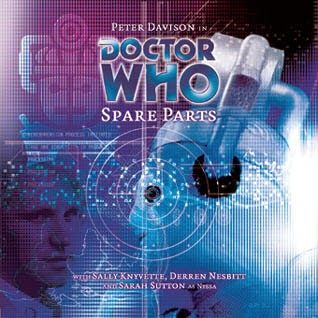
34. Spare Parts.


4 episodes. Approx. 120 minutes. Written by: Marc Platt. Directed by: Gary Russell. Produced by: Gary Russell, Jason Haigh-Ellery. 


THE PLOT

The TARDIS materializes on the planet Mondas - the homeworld of the Cybermen. Though the Cybermen have not yet replaced the human race, Mondasian humanity is in its dying days. The surface of the rogue planet has frozen over, driving the survivors underground. Only one human city still stands, its population afflicted with illness. Crews are selected from the sickest of the residents. They are processed, "augmented" with cybernetic technology in order to work on the otherwise uninhabitable surface, building a planetary propulsion system to return them to their home sun.

Once the Doctor realizes where they are, he insists that they cannot interfere and should leave immediately. But Nyssa has already befriended the Hartley family, recognizing them as good people undeserving of the fate that awaits them. She pushes the Doctor to at least intervene a little... and that little is enough to mark them as outsiders, with the Cyber-augmented "planning committee" ordering them arrested and brought in for interrogation!


CHARACTERS

The Doctor:
 Recognizes very quickly that this is Mondas before the Cybermen, something he tries to conceal from Nyssa. When she confronts him at the end of Part One, he insists that neither of them can change this world's fate. Even so, he can't stop himself from making multiple attempts to wake the people of Mondas up to what is happening around them. The future may be inevitable, but when the horror is right in front of his face, he will make an attempt to shift its course. Peter Davison has rarely been better, compassion, sarcasm, and an angry ferocity he was too often denied by his television scripts all perfectly balanced.

Nyssa: While the Doctor makes an inevitably doomed attempt to alter the future on a large scale, Nyssa helps on a smaller one: Helping to fix Mr. Hartley (Paul Copley)'s mechanical heart, for instance, or bringing food to the Hartley family to repay what she has eaten. She continues to feel pain at Adric's death, and seeing the birth of the Cybermen makes that all the stronger. When the Doctor urges that they should leave at the end of Part One, she wields Adric's fate like a weapon against his arguments. 

Cybermen: Several of this serial's Cybermen are first seen as human characters. One is plucky and likable, another officious and humorless, yet another rather shady and potentially dangerous. All are fully human creations, which makes it that much more effective to see them reduced to machines by the story's end. Nicholas Briggs voices most of the Cybermen, and offers a different sound for each stage. The recognizably human police are presented as semi-Cybermen, with a light electronic treatment given to a voice recognizably Briggs' own. The full Cybermen, little heard in the story's first half, have the full Tenth Planet voices. The lead Cyberman, Commander Zheng, also has that voice but with a deeper tone. This makes it easy for the listener to differentiate one "class" of Cyberman from another, aiding visualization while showing each successive generation moving further away from human and toward machine.


THOUGHTS

Spare Parts is Doctor Who's best Cyberman story. I make this statement without any equivocation. It is not merely the best Cyberman story on audio. It is the best Cyber-story across all media and all incarnations of the Doctor Who franchise.

I did enjoy the new series' Rise of the Cybermen, which recycled a handful of the ideas from this audio into an effective television action story. But this is a much more meaningful piece, with far greater emotional impact. Writer Marc Platt hasn't turned out an action story, though there's certainly action in it. As he explains in his author's notes, he rejected the idea of having a "Cyber-Davros" (something this story's television counterpart did indulge in), and instead crafted a human tragedy.

The most memorable scene comes in Episode Three. A power outage has interrupted a Cyber processing line, and one of the half-processed Cybermen has enough of its human memory to find its way home, to a reunion with its family. The reunion scene is genuinely devastating, one of the most vivid single moments in all of Doctor Who.

Russell Stone contributes another terrific score, starting with a jaunty patriotic tune accompanying a newsreel, then distorting that same tune into something discordant and mournful. The score gradually moves toward the mechanized as the Cybermen move from the periphery of the narrative to the center of it, until we get a full Cyber-score backing the action of the final episode. 

Guest performances are mostly excellent, in well-realized roles. Special mentions go to Sally Knyvette's Doctorman Allen, taking refuge in heavy drink and cynicism as she sees her good intentions transforming into something monstrous; Paul Copley's warm but defiant Mr. Hartley; Darren Nesbitt's grasping, deceitful Dodd; and of course, Nicholas Briggs' Cybermen. The only weak link in the cast is Jim Hartley as young Frank Hartley, who starts out sullen and resentful before emerging as an ally. Hartley's wooden line readings contrast sharply with the outstanding performances surrounding him. Fortunately, it's a decidedly supporting role and his relative weakness does little damage to the piece.

Released in 2002, Spare Parts remains not only a highlight of the Big Finish audio range but one of the entire Who franchise. It is fortunate that when the new series produced Rise of the Cybermen, the decision was made to set it in a parallel reality so as not to conflict with this story. If the two Cyber-origin stories had conflicted, I'm sure I'm not the only one who would have chosen this one over its television counterpart.


Overall Rating: 10/10.

Previous Story: Primeval
Next Story: Creatures of Beauty

Search Amazon.com for Doctor Who

5th Doctor Audio Review Index

5th Doctor Television Review Index

Doctor Who Monthly Adventures Review Index

To receive new review updates, follow me:

On BlueSky:

On Threads:

Friday, December 31, 2010

17. Sword of Orion.


4 episodes. Approx. 123 minutes. Written by: Nicholas Briggs. Directed by: Nicholas Briggs. Produced by: Gary Russell, Jason Haigh-Ellery.


THE PLOT

The Doctor brings Charley to the Garazone System, home to a bazaar where one can find almost anything - hopefully including a cure for Ramsay, the vortisaur who rescued them from the crash of the R101. Ramsay has fallen ill due to separation from the Time Vortex, and now is too weak to be returned to his "natural habitat." But while he and Charley browse the bazaar, the TARDIS is loaded onto the scrap ship Vanguard, leaving the time travelers with no choice but to stow away before the ship takes off.

The Vanguard is under the command of a new captain, Deeva Jansen (Michelle Livingstone) - A woman who does not appear to belong among these mercenary salvagers. Deeva is possessed of a military efficiency, and delivers orders with the certainty of someone used to being obeyed without question. She plots a very specific course, one that brings the Vanguard directly to a derelict star destroyer, a find that other scrap ships have left alone because it's too big to salvage.

She orders her crew to spacewalk over to the derelict. The ship initially appears empty, its systems heavily damaged by an ion storm. But they all too soon discover its inhabitants: Cybermen. They rode out the storm in a state of hibernation. Now that the storm has passed, they are starting to awaken, with only one purpose in their cybernetic minds:

Conversion!


CHARACTERS

The Doctor:
 As the synopsis above shows, the Doctor doesn't really have a very proactive role in this story. Once he and Charley are aboard the Vanguard, their main goal for the rest of the story is simply to reach the TARDIS and escape. Once it becomes clear that the derelict star destroyer is a Cyber-ship, the Doctor does use his ingenuity to try to keep the salvage crew alive... but the person truly driving the action in the Cyber plot is Deeva, with the main complications provided by the ruthless Grash (Bruce Montague), leaving the Doctor largely reacting to events as they unfold. Paul McGann remains as game here as he was in Storm Warning, however, which helps to make the Doctor's role feel more central than it truly is.

Charley: India Fisher remains an engaging co-star, showing a strong interplay with Paul McGann and giving a lot of emotion and expression in her line deliveries. Charley herself gets less to do in this story, however, largely filling generic companion functions. She's held hostage by the salvage crew while the Doctor and Deeva explore the Cyber-ship. Once reunited with the Doctor, she tags along with him, following his lead. The script also gives her a few too many smug quips, particularly in the first half, undercutting the character's inherent likability a bit.

Cybermen: This story presents the Cybermen in a weakened state. Their ship and systems have been crippled by an ion storm, and they are only able to awaken from hibernation one Cyberman at a time. This allows for a slow burn in the story's first half. A "rogue Cyberman," deranged due to storm damage, kills a crew member at the end of Part One, before being killed in turn. A Cybermat smuggles itself aboard the Vanguard, sabotaging the scrap ship and making it impossible for the humans to simply escape. But this also makes it impossible for the Cybermen to escape. With their ship's shields already destroyed, the next ion storm will eradicate them. Even so, they carry on with their directive, working to capture and convert the Vanguard crew, even when all that will accomplish is giving them a handful of additional Cybermen to be destroyed when the storm hits.


THOUGHTS

Sword of Orion is an example of what I tend to call "Saward Who." Like (too) many stories from Eric Saward's tenure as script editor, the story's guest cast is stuffed with unpleasant mercenary characters who spend at least as much time menacing the Doctor as working with him. There is a sense of nihilism throughout, and as the body count rises in the final episodes, it ultimately leaves events feeling less tragic than pointless.

The story's characters are a grim lot. Grash is a borderline psychopath; the crew members are alternately selfish, cowardly, and stupid; Deeva, whom we are encouraged to find sympathetic, is cold and hides an agenda that would have far-reaching and devastating consequences. But the story is well-made and well-paced, and somehow the characters manage to work within the framework they're given.

Part of this rests in Nicholas Briggs finding moments to give to each of them. Grash may be a murderous criminal, but it's clear that he's genuinely appalled and angry at the death of one of his men. The final episode of the story gives him a moment that's pitiable even as it's a moment of triumph, as he reponds to Cyber-conversion by spitting out increasingly insane threats. His mind is apparently broken, but he wins his battle of will, as the Cybermen dub him "unsuitable for conversion." And though we have no reason to particularly care about Ike, Chev, or Vol, the scenes in which they're in jeopardy are individually gripping. That's in addition to Deeva's final (somewhat cliched) act of personal heroism. The characters are dingy and sleazy people in a dingy and sleazy world, but there's just enough human dignity in them to make this work on a level other than that of a well-produced slasher flick.

It is particularly well-produced, even by Big Finish's generally reliable standards. The doors of the scrap ship squeal, speaking to the lax maintenance. On the Cyber-ship, footsteps echo with a wonderfully ominous quality, and spooky, shadow-filled visuals are conjured in the mind. Gone is the labored visual exposition that marred the otherwise very good Storm Warning - A mix of subtle dialogue cues and sound effects are trusted to create the pictures. Writer/director Nicholas Briggs also composes the incidental score, a very mechanical one well-suited to the Cybermen, and highly effective in evoking the dark, ominous atmosphere.

But that bitter "Saward Who" aftertaste lingers, keeping me from fully embracing this story despite having been engrossed in it while listening. A little too much like stories from the Saward era, the Doctor's role feels a bit too perfunctory. He and Charley are present for events, but they aren't very proactive. The Doctor is largely just present. Briggs' script allows him a few moments of cleverness, most notably the bit in Episode Three in which he sabotages the airlock to thwart the Cybermen's attempted invasion of the Vanguard. But he doesn't really drive the action, he just reacts to it. The main guest character, Deeva, ends up doing a lot more to drive the plot than the Doctor does.

The story is well-made and it provides an engrossing two-hour diversion. But the unpleasant characters, the Doctor's weak role, and the overall sense of futility keep this from being anything more than average in my view.


Overall Rating: 6/10.

Previous Story: Storm Warning
Next Story: The Stones of Venice

Search Amazon.com for Doctor Who

8th Doctor Audio Review Index

8th Doctor Television Review Index

Doctor Who Monthly Adventures Review Index

To receive new review updates, follow me:

On BlueSky:

On Threads: